Reclaiming Art as Reparations: African Art Theft at the Quai Branly Museum in Paris
By Rachel Miyamoto
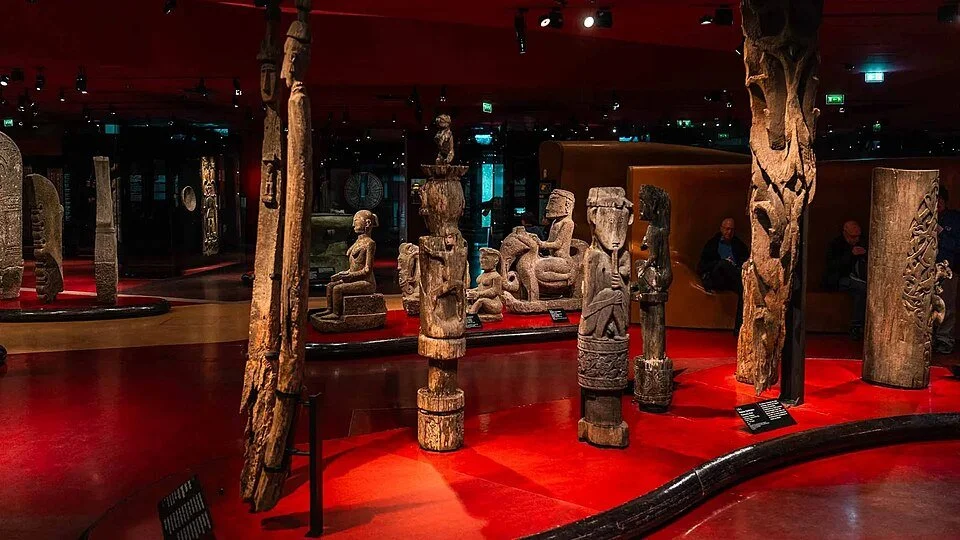
Quai Branly Museum. Christiane Lamat, via Wikimedia Commons.
In June 2020, Congolese activist Mwazulu Diyabanza, along with four other accomplices, stole a nineteenth-century African funeral pole from the Quai Branly Museum in Paris. Instead of refuting the charge, Diyabanza used his trial to call attention to France’s colonial history in Africa and lambast French authorities for their failure to provide adequate restitution.
Diyabanza has a point. At the time of the theft, the funeral pole was not the only sub-Saharan African art piece that remained in France: an estimated 90,000 artifacts that the French stole during the colonial period were still kept in French museums. Though President Emmanuel Macron promised to return African artworks to their countries of origin in 2017, only twenty-seven restitutions were pledged, and only one artifact was returned.
As if the initial theft of the artifacts from their home countries wasn’t bad enough, the treatment of these artifacts once they reached France added insult to injury. Rather than providing a platform for the colonized to celebrate their achievements, museums in France showcased artwork and architecture from colonized countries as if they were uniquely French cultural accomplishments.
The disregard for the true history and context of African objects also translated to the disregard for and objectification of Africans themselves, as demonstrated by the 1931 Paris Colonial Exhibition. Billed as a way to bring people across the empire together, the event instead functioned as a kind of human zoo, in which racialized images of colonial subjects were displayed for the entertainment of Metropolitan citizens. Just as French colonizers failed to understand African culture in the human zoos, the French also fetishized African American entertainers during the interwar period, viewing them as authentically African.
Because of this colonial imagination, French audiences had equated Black Americans to African colonial subjects and reduced them to a stereotype. This obsession with African culture and primitivism was epitomized through Josephine Baker, an African-American dancer and singer who the French highly sexualized. Her appearance in the 1926 show La Folie du Jour portrayed her as a “genial, uninhibited savage” in a skirt of bananas that was “a perfect symbol of both sexuality and primitivism.” Here, France placed someone of non-French origin on display and claimed her as if she were born in the Empire. Moreover, the fixation with her primitivist image reduced Baker’s Africanness to an object of sexualization, rather than appreciate her as a person. This objectification and claim over the African image was reflected in the maintenance of art in the Quai Branly Museum, which paraded colonial artifacts and hid their true origins of theft.
In addition to the French government’s broken promises of restitution and failure to fully contend with France’s colonial legacy, the activists who robbed the Quai Branly Museum did so because they recognized that art from their homelands should not be presented in French museums as mere works on display. As one of the defendants, Julie Djaka, remarked, the art pieces were “entities, ritual objects that maintained the order at home, in [their] villages in Africa, that enabled [them] to do justice.” Since the stolen pole represented the effects of colonialism as well as African culture and history, its theft symbolized a reclaiming of heritage and the pursuit of colonial restitution to decolonize fully.
Bibliography
Cross, Elizabeth, “The Interwar Period and the Popular Front,” History 2422: The French Empire Since 1600 (class lecture, Georgetown University, Washington, DC, November 5, 2024).
Méheut, Constant, and Antonella Francini, “France’s Colonial Legacy Is Being Judged in Trial Over African Art.” New York Times. September 30, 2020. Accessed December 3, 2024. https://www.nytimes.com/2020/09/30/arts/design/france-african-art-trial.html.
Stovall, Tyler. Paris Noir: African Americans in the City of Light. Houghton Mifflin Company; 1996.
