From Umpires to AI: The Evolution of Strike Calling in Baseball
By Henry Johnson
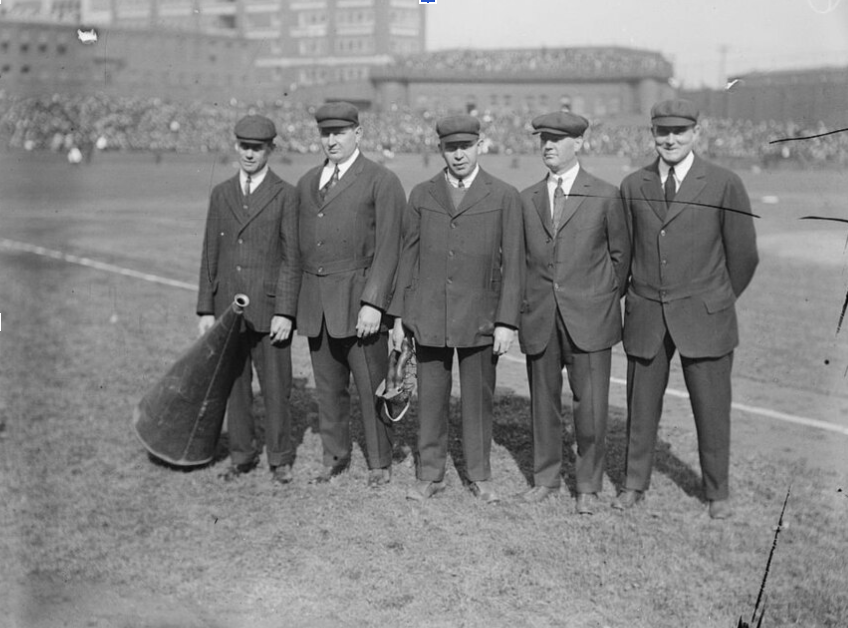
Umpires at 1915 World Series. Public domain, via Wikimedia Commons
In the short span of time since the 2026 Major League Baseball (MLB) season kicked off on Opening Day, the implementation of the Automated Ball-Strike (ABS) challenge system has already had a profound impact on the game. For over a century, the strike zone was the exclusive domain of human umpires, making their judgment on pitches final. Now, players can appeal human decisions to artificial intelligence, fundamentally reshaping the way that pitches are called. Yet, throughout the history of America’s Pastime, strike calling has never been static. Rather, it has evolved continuously alongside the sport itself. Tracing this history of strike calling reveals not only the impact of new rules or technology, but shifting conceptions about fairness, entertainment, and the value of human error in baseball.
In the late 1840s, the rules of baseball were designed to maximize the likelihood that the ball would be put into play. Pitchers were expected to provide easy-to-hit pitches for batters, with the burden of recording outs falling primarily on the fielders. Batters were not required to swing at any pitch, but a missed swing counted as a strike, and three strikes resulted in a “hand-out.” However, these rules created a serious issue. Given that mitts were not yet commonplace, the ball frequently got past the catcher, creating an opportunity for any runners on base to advance. Some batters, aware that there was no penalty for taking a pitch, would refuse to swing until the ball inevitably got loose, enabling teammates to advance repeatedly. In response, Daniel “Doc” Adams of the Knickerbocker Club proposed the “called strike” in 1858. This rule allowed umpires to discretionarily call a strike on any legal pitch within reach of the bat and not swung on by the batter. This early change was one of the first attempts to introduce fairness and action back into the game.
However, the called strike did not immediately have the desired effect. Many umpires remained unwilling to call strikes on batters because there was no similar penalty they could impose on pitchers. Around the same time, pitchers began to throw forcefully with the goal of intimidating the batter or inducing him to swing at unhittable pitches. In 1864, the National Association of Base Ball Players (NABBP) introduced “balls” and the “base on balls” to remedy both issues. Under this rule, the umpire could call a ball on pitches deemed unhittable and award the batter first base if three balls were pitched. It was theorized that this rule would incentivize umpires to begin calling strikes and encourage more accuracy from pitchers. Yet, many umpires remained reluctant to inject themselves into the game and would therefore call strikes on only the most egregious failures to swing.
Gradually, umpires began to warm to the practice of strike calling in order to combat lengthy games and perceived unfairness. In 1871, a rule change allowed players to request a “high ball,” “low ball,” or “fair ball” from the pitcher. A “high ball” was defined as passing over the plate between the shoulders and waist of the batter; a “low ball” was required to pass over the plate between the waist and a foot off the ground; a “fair ball” had to pass anywhere over the plate between the shoulders and a foot off the ground. By 1886, this rule was repealed, but not before the measurements it provided helped give rise to an official strike zone. In 1887, the National League defined a strike as a pitch that passed over the plate and not below the batter’s knees or above their shoulders. Thus, the strike zone took on its familiar rectangular shape, which ensured greater consistency as umpires began calling strikes.
By 1901, the National League had adopted the “foul strike,” followed by the American League in 1903. Under this rule, any ball batted into foul territory was a strike unless two had already been called. The foul strike, combined with practices such as the spitball, contributed to the dead-ball era, where games averaged low scores and few hits. During this period, the strike zone itself remained unchanged. It wasn’t until 1950 that the strike zone was altered for the first time in decades. The new definition incorporated the batter’s natural batting stance for the first time, while also lowering the top of the zone to the batter’s armpits. However, following a period of successful offense, in 1963 the MLB reverted to the old zone of between the top of the shoulders and knees.
This change would prove to be short-lived. Following a 1968 season dubbed the “Year of the Pitcher,” the MLB shrunk the zone back down to the armpit in order to curb pitcher dominance. In 1988, the MLB shrunk the zone again, lowering the upper edge to the midpoint between the top of the shoulders and the top of the pants while keeping the lower edge at the top of the knees. Finally, in 1996, the MLB made its most recent change to date to the strike zone. For the first time, the bottom of the zone was expanded, moving to the hollow area just below the knee, giving us the strike zone that exists today.
