Paradise Lost: The Marshall Islands and America’s Nuclear Legacy
By Alex Martin
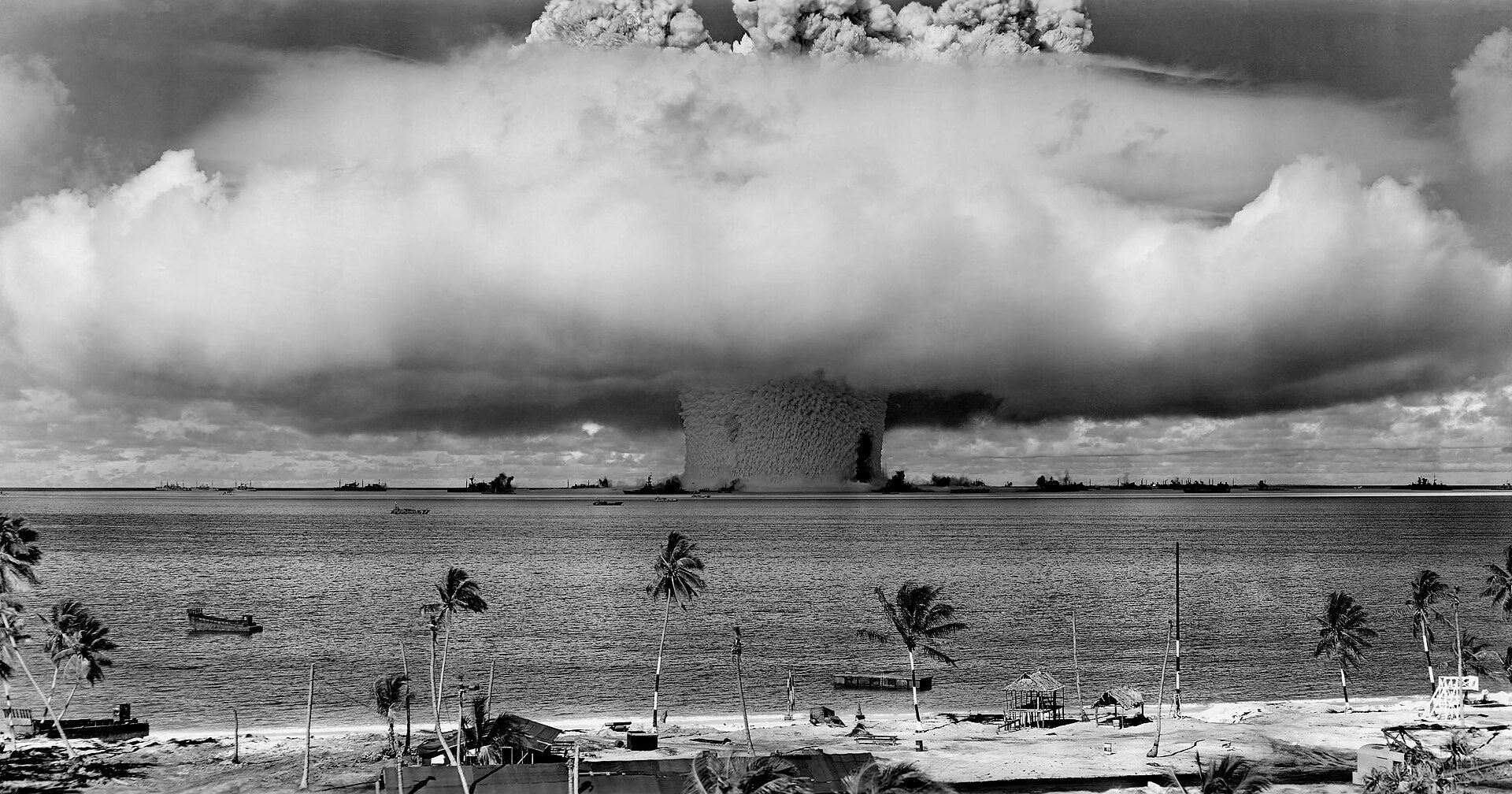
The "Baker" Explosion, part of Operation Crossroads, a US Army nuclear test at Bikini Atoll, Micronesia, on July 25, 1946.
While tropical islands may feature prominently on students’ minds at this time of year, few of those planning exotic spring break adventures are likely thinking about the United States’ long and difficult history with these regions. If considering a trip to the Pacific, modern vacationers tend to be drawn to Fiji, Bora Bora, or the Cook Islands, all of which are known for their white sand beaches and turquoise waters. Why these islands? Why not, for instance, the Marshall Islands? Despite their prime location and natural beauty, the Marshall Islands remain one of the least-visited countries in the world. The answer here lies in the nation’s relationship with the United States and its exploitation as the United States’ “Pacific Proving Grounds.”
After World War II’s technological breakthroughs in nuclear warfare, the United States continued its nuclear testing program in the Marshall Islands from 1946 to 1958. Here, the Americans conducted 67 total nuclear tests, including the largest nuclear weapon the U.S. ever detonated, a hydrogen bomb called the Castle Bravo Bomb. The brutality of these nuclear tests destroyed much of the islands’ natural beauty, immediately obliterating reefs and landmasses, in an act of mass destruction that the island nation is still recovering from today. As a consequence of these tests, between 28 and 42 species of coral have gone locally extinct and elevated levels of gamma radiation and cesium-137, plutonium, and americium are still found in soils across multiple atolls.
However, the repercussions of U.S. nuclear testing in the Pacific extend beyond environmental damage. The United States’ treatment of the local population during this period was often dismissive. After gaining control of Micronesia (which included the present-day Marshall Islands) from Japan under the UN Trust Territory of the Pacific Islands in 1947, the U.S.forcefully removed local populations from the Enewetak Atoll and Bikini Atoll, denying them access to their home for more than thirty years. The Bikinians were eventually allowed back in 1971, but were re-evacuated in 1978 after dangerous levels of cesium-137, a radioactive isotope, were found in their bodies. The Enewetakese were allowed to return to their atoll in 1980 after a three-year radiation clean-up project where the radioactive debris was buried under a concrete dome on Runit Island, but the Bikinians have still not been allowed to permanently return to their home due to persistently high radiation levels.
The 1983 signing of the Compact of Free Association (COFA) transitioned the Marshall Islands from a UN Trust Territory to a self-governing nation, requiring a new legal framework to shape its relationship with the United States. Under the COFA Settlement of Claims (Section 177), the United States agreed to pay the Marshallese people $183.7 million in reparations for the damages caused by the nuclear testing. While this amount may seem substantial, it pales in comparison to the claims filed by the Marshallese against the U.S. government, which came out to more than $5 billion. A portion of the $183.7 million has been set aside to establish the Nuclear Claims Tribunal, which was intended to provide monetary compensation for radiogenic illness and land damage. The Nuclear Claims Tribunal has awarded $2.2 billion for personal injury and property damages, but, due to the limited size of the fund, has been unable to fully pay all claimants.
In conclusion, there is a reason why you aren’t considering the Marshall Islands as a top destination for your spring break vacation. The past eighty years have left an indelible mark on the ecological, humanitarian, and economic reality of the Marshall Islands with little international aid offered, reminding us that beneath the image of a tropical paradise there lies a history of exploitation whose consequences are still heavily felt today.
Bibliography
Abella, Maveric K. I. L, Monica Rouco Molina, Ivana Nikolić-Hughes, Emlyn W. Hughes, and Malvin A. Ruderman. "Background Gamma Radiation and Soil Activity Measurements in the Northern Marshall Islands." Proceedings of the National Academy of Sciences 116, no. 31 (2019): 15425-34. https://doi.org/10.1073/pnas.1903421116.
Courchesne, Christophe. "Restoration of the Marshall Islands: The Time Has Come for the U.S. to Reckon with its Past and Rebuild Trust in the Region." Vermont Journal of Environmental Law, 2023. https://vjel.vermontlaw.edu/top-ten/2022/12/restoration-of-the-marshall-islands/.
Lubofsky, Evan. "Back to Bikini." Oceanus. Woods Hole Oceanographic Institution. Last modified June 5, 2017. https://www.whoi.edu/oceanus/feature/back-to-bikini/.
Pevec, Davor. "The Marshall Islands Nuclear Claims Tribunal: The Claims of the Enewetak People." Denver Journal of International Law & Policy 35, no. 1 (2006).
Richards, Zoe T., Maria Beger, Silvia Pinca, and Carden C. Wallace. "Bikini Atoll Coral Biodiversity Resilience Five Decades after Nuclear Testing." Marine Pollution Bulletin 56, no. 3 (2008): 503-15. https://doi.org/10.1016/j.marpolbul.2007.11.018.
Smith-Norris, Martha. "American Cold War Policies and the Enewetakese: Community Displacement, Environmental Degradation, and Indigenous Resistance." In Domination and Resistance: The United States and the Marshall Islands during the Cold War, 16-42. University of Hawai'i Press, 2016. https://doi.org/10.2307/j.ctvvn1rb.5.
U.S. Department of State, Report Evaluating the Request of the Government of the Republic of the Marshall Islands Presented to the Congress of the United States of America, H.R. Rep. (Nov. 2004). https://2001-2009.state.gov/p/eap/rls/rpt/40422.htm.
