‘Educate a Woman, You Educate a Race:’ When Freedom Means Assimilation
By Sophia Tremblay
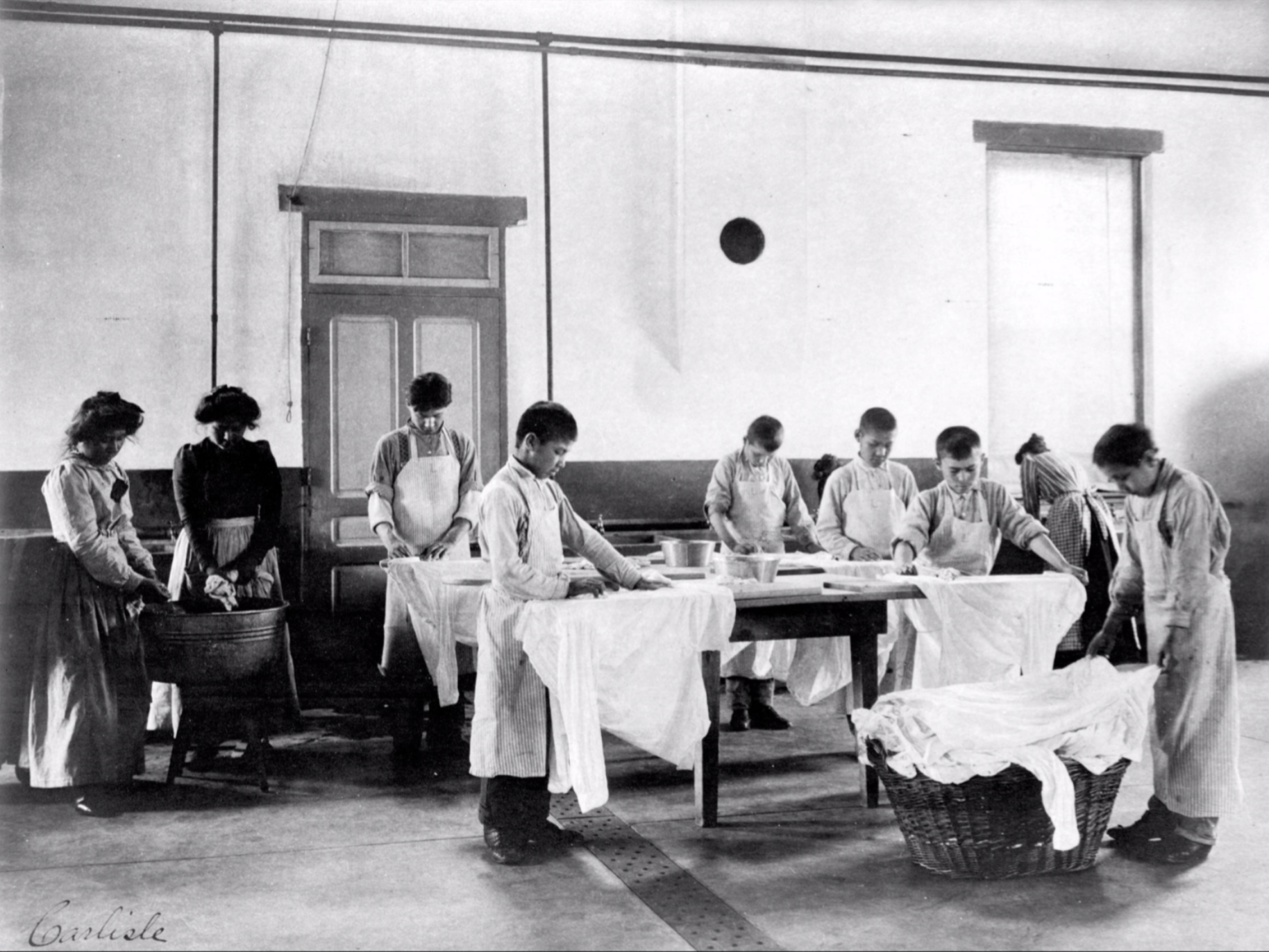
Picture: Frances Benjamin Johnston. Laundry Class, Carlisle Indian School. Ca. 1900-03.
As the United States approaches the celebratory 250th anniversary of its founding, it is essential to consider what independence and “freedom” meant for those who were not granted full autonomy within the nation. For many groups, particularly Native Americans in the 19th century, American expansion and the process of nation-building brought not freedom as we may conceptualize it, but forced cultural transformation carried out by institutions such as government-run boarding schools.
Government-run education for Native Americans was by no means new in the 19th century; missionary schools had been around for centuries prior, in hopes of converting Indians to Christianity. However, the 19th century marked a significant expansion of these efforts, as many government officials decided that the way to solve their so-called “Indian problem” was through assimilation, and many thought the most efficient way to achieve this change was to start with children. Richard Pratt, the founder of the Carlisle Indian School, encapsulated Native boarding schools’ mission as being to “Kill the Indian and save the man.”
To “kill” the Indian in children also meant to kill any current understanding of gender roles. Many in Victorian America believed that the Indian woman was inadequate and needed drastic correction. Thus, learning Euro-centric gender norms was at forefront of these schools’ curriculum. School officials carefully crafted a rhetoric that redefined the Native woman’s role, and provided steps on how to accomplish true Victorian womanhood in various school publications. In The Red Man, a Carlisle Indian School newspaper, an article from 1891 titled “The Modern Indian Girl” reflects on the remarkable shift Indian girls go through during their time at boarding school. “When she doffs her graduation gown and steps forth to face the world,” it claims, “she is a woman in every sense.” This statement implies that only when an Indian woman embraces Anglo-American values will they feel like a true woman, and that this transformation will bring both admiration from society and increased self-respect.
The article extends beyond an Indian woman’s transformation and also assigns her the task of “civilizing” her male peers. The article states, “It is her function to arouse him from his lethargy, and to show him the preservation of the race lies not only in accepting the ‘inevitable’ but in reaching out and grasping it; in taking up the ‘white man’s burden’ and carrying it along in the march of progress.” This rhetoric shifts the apparent “white-man's burden” onto Indian women, framing their worth on not only their ability to reform themselves according to Eurocentric values, but also their communities. Implicitly, school officials were telling Indian girls that their only value comes in abandoning their Indian identities and influencing the men around them to do the same: a harsh and dehumanizing message for the young female student body.
Through seeking to make female Indians fit into the rigid frameworks of Victorian America, the notion of freedom thus became quite limited. These strict boundaries in which Indian girls and boys were placed left a lasting mark on the young students. The forced dismantling of mother-daughter relationships, coupled with graduates’ fragmented understanding of identity, has led to cycles of trauma that persist in several parts of the Native American community today. Perhaps then it is important to remember as many celebrate the “freedom” and “progress” that emerged as a result of the American Revolution often came at the expense of Native American communities and their cultural norms in the centuries that followed. The very nation that championed liberty simultaneously constructed systems designed to deny those same principles to Indigenous peoples, recasting assimilation as progress. Thus, as celebrations commence this upcoming July, it is essential not only to honor these ideals of American freedom themselves, but also to go a step further by engaging critically with the ways in which they were unevenly applied.
Bibliography:
Child, Brenda J. 1998. Boarding School Seasons: American Indian Families, 1900-1940. Lincoln: University of Nebraska Press. ProQuest Ebook Central, 78.
Devens, Carol. “‘If We Get the Girls, We Get the Race’: Missionary Education of Native American Girls.” Journal of World History 3, no. 2 (1992): 221. http://www.jstor.org/stable/20078530.
Smith, Andrea. “Boarding School Abuses, Human Rights, and Reparations.” Social Justice 31, no. 4 (98) (2004): 89. http://www.jstor.org/stable/29768278
“The Modern Indian Girl.” In Carlisle Indian School Digital Resource Center. Previously published in the The Red Man, July 1891, 24. https://carlisleindian.dickinson.edu/sites/default/files/docspublications/IndianCraftsman_V02n03c.pdf
